When I think back on how I became happily addicted to books and
reading, I inevitably focus on three things: ice cream, Europe, and mean
kids.
Let me explain.
1. Ice Cream

3/19/14
Books to Look For (March): Science Fiction, Fantasy, & Humor
Science Fiction
William Shakespeare’s The Empire Striketh Back by Ian Doescher (Quirk Books, 176 pages, March 18)
Since William Shakespeare's Star Wars proved to be an "interstellar best seller," of course we expected a sequel! Well, here it is, in all its theatrical glory. And Yoda looks damn good in that frilly outfit, don't you think?
My Month of Crime Fiction: The Friends of Eddie Coyle by George V. Higgins
If the guys in this novel are Eddie Coyle's "friends," I
don't want to know what his enemies are like.
In this terse, stark novel, Higgins reveals a tightly-interconnected
world of gang members, gun runners, hitmen, and thieves. While Eddie,
Scalisi, and Dillon are all using one another to set up jobs, they're
simultaneously informing on one another to the cops. Eddie, though,
has the most to gain by talking- if he can convince the DA that he's
been helpful in capturing other criminals, he can get a light
sentence for his own crimes. Ultimately, though, Eddie has much worse
coming to him.
3/17/14
Rachel's Random Recommendation #26: The Devil in the White City by Erik Larson
Ok, everybody, I give you permission to tell yourself that this work of nonfiction is actually a novel. Go on, I understand. I had the same urge myself when I finished it.
Because who wants to think about a crazy, psychopath serial killer roaming the grounds of the Chicago World's Fair of 1893 and luring his female victims into his "hotel" where he subsequently murdered them? Ok, he didn't necessarily lure women from the fair itself, but he did capitalize on the massive influx of people that turned Chicago into a boisterous, crowded free-for-all at a time when the U.S. was showcasing its technological and scientific innovations.
3/14/14
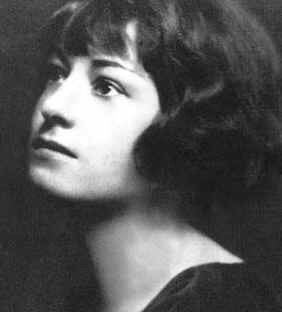
Dorothy Parker Harshing on Bad Books
But who can write reviews like Dorothy Parker? After all, this is the same woman who claimed that “the first thing I do in the morning is brush my teeth and sharpen my tongue.” Well, I hereby present to you a few choice excerpts from her column “Constant Reader” (1927-1933), which ran in The New Yorker. It’s harsh stuff (but hilarious at the same time). I’ve thrown in some Parker portraits, as well, just because I like you.
3/13/14
My Month of Crime Fiction: The Talented Mr. Ripley by Patricia Highsmith
I'm sensing a pattern here. The crime fiction I'm reading is coming
in pairs- pretty creepy. First, I read two novels written by men from
the perspective of a private investigator, and then I read two books
written by women from the perspective of a male serial killer. To
this I say: iiiiiinnnnnteresting...
But
I'll think more about that later, because The
Talented Mr. Ripley
is in the spotlight at the moment. And oh MAN what a book.
Highsmith's style is superbly subtle, nuanced, almost lyrical at
times. It's the kind of writing that makes itself transparent so that
only the story exists (what someone once said is the mark of the best
kind of writing- sorry, I forgot who said that).
3/12/14
Books to Look For (March): History, Comics/Graphic Novels, & Travel
History
The Golden Age Shtetl: A New History of Jewish Life in East Europe by Yohanan Petrovsky-Shtern (Princeton University Press, 448 pages, March 30)
Ah, the "shtetl." Most of us probably think about Fiddler on the Roof when that word pops up, but Petrovsky-Shtern reveals the many other dimensions of shtetl life that had fallen out of memory. Home to most of East Europe's Jewish population during the 18th and 19th centuries, shtetls were centers of learning and trade, more vibrant than the poverty- and fear-stricken villages we might imagine. So if your Bubbe's birthday is coming up, you might consider giving her this. And your cheek to pinch, too. And you'll of course have to stay for a 10-course meal...just sayin'.
3/11/14
My Month of Crime Fiction: In a Lonely Place by Dorothy B. Hughes
Allow
me to introduce you to In
a Lonely Place-
it's chilling, it's creepy, it messes with your head, and it is
FANTASTIC.
My
copy of this novel was published by The Feminist Press as part of a
series called "Femme Fatales: Women Write Pulp," in an
effort to bring back mid-century classic pulp stories written by
women, including noir. Like a parallel effort in the realm of
mid-19th century American sentimental fiction, this series
reintroduces us to the rich and varied world of crime/noir fiction
that wasn't just hard-boiled male detectives pawing bad girls with
too much lipstick while hunting down murderers and tossing them to
the cops. No, noir was much more than that: it included many female
writers, like Hughes, Highsmith, and Sayers, who explored the
20th-century American psyche and the hidden depths of many so-called
"ordinary" people. Why did some people become killers? What
kind of figurative masks did they wear to pass unnoticed, permitting
them to murder while also moving about in cultured society?
3/10/14
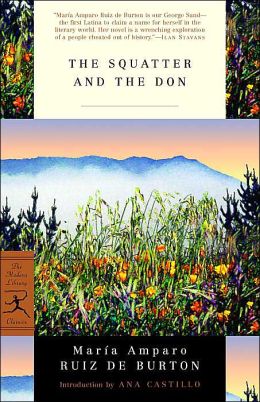
Rachel's Random Recommendation #25: The Squatter and the Don by Maria de Burton
In the whole of my professional life so far, I have taught only one lecture course: a survey of American lit. Now I could go on and on about the problems with this kind of teaching/learning structure, but that's for another time and another rant. For now, I want to introduce you (if you've never heard of her before, and many haven't) to Maria Amparo Ruiz de Burton.
3/8/14
5 Books to Watch for in March
3/6/14
My Month of Crime Fiction: The Big Sleep by Raymond Chandler
Perhaps
The Maltese
Falcon,
plus all the clips of black-and-white Bogart films I've seen over the
years, made me think that all crime fiction would be dark and
depressing. After all, Hammett's novel wasn't exactly chipper. But I
wasn't even past the first page of The
Big Sleep
when I started chuckling. This, I thought, this is gonna be an
enjoyable ride.
Let
me explain by example. Philip Marlowe, narrator and private eye
extraordinaire, cockily presents himself as "neat, clean, shaved
and sober, and I didn't care who knew it. I was everything the
well-dressed private detective ought to be. I was calling on four
million dollars." BAM.
You can't beat a description like that. And the clocks on his socks?
Wonderful touch.
3/5/14
Books to Look For (March): Biography, Literary Fiction, & Mystery
Biography
Whistler: A Life for Art's Sake by Daniel E. Sutherland (Yale University Press, 440 pages, March 4)
We've all seen the painting of Whistler's mother, but there's so very much more to this artist. Between feuding publicly with Oscar Wilde and John Ruskin, and chasing perfection in his painting, Whistler helped shape a generation of American artists during the 19th century. Sutherland makes extensive use of the artist's letters to tell this story.
3/4/14
My Month of Crime Fiction: The Maltese Falcon by Dashiell Hammett
While
reading The Maltese Falcon,
I had the strangest sense of déjà vu, as if I'd seen/read all of the
novel's elements before: the chain-smoking private eye; the
mysterious, sexy lady client asking the detective for help; the
motley group of criminals ultimately caught in the detective's net,
etc. etc. Of course, that's because I had: The Maltese
Falcon has seeped into our
cultural consciousness, until the Private Investigator/Detective is a
well-recognized figure in the crime/noir genre. Much riffing has
been done on these elements, and the films and books that developed
from and around it are too numerous to discuss here (although
Chandler took Hammett's formula and brought it to new heights). I
kept thinking about tv shows of the 1960s like Dragnet
and Get Smart (specifically,
the hilarious episode "Tequila Mockingbird"). There's even
a recent Sesame Street spoof on the "Private I."
3/3/14
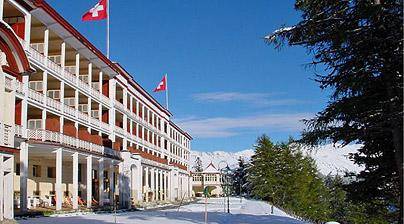
A Bookish Hotel for Your Bucket List
Yes, yes, I know it’s not my birthday or a gift-ish holiday, but hear me out.
I just learned about the hotel in the Alps that is a destination for those who adore Thomas Mann’s The Magic Mountain. How could I not have heard of this before?? You NEEED to fund my trip there. (Please).
You see, just the other day, I was skimming through my Twitter feed when…wuuuut?…a headline from the New Yorker popped out at me about The Magic Mountain. Since I only know a few other people who adore this book like I do, I sometimes forget that others even know about it and go to the trouble of actually visiting the places that Mann references. It truly never occurred to me to go questing for the equivalent of the Berghof in the Swiss Alps (probably because the next time I get to go to Switzerland, my hair will be gray instead of brown).
Rachel's Random Recommendation #24: The Female Quixote by Charlotte Lennox
The Female Quixote (1752) by Charlotte Lennox"Whoa now," I hear you say, "you're dragging us back into the 18th century now?"
Yes, dear readers. Yes I am.
Never would I have heard of Charlotte Lennox or her wickedly-funny novel had I not taken a grad seminar on 18th century lit. Now, this is the same class that brought me Clarissa, through which I plodded for hundreds of pages until I JUST. COULDN'T. TAKE. IT. ANYMORE. If you've tried reading Clarissa, you'll know what I mean.
2/28/14
March: My Month of Crime Fiction
During the month of March, I'll be diving into modern crime fiction for the first time. I've chosen these seven novels based on recommendations from some fabulous bookish people, crime-fiction lists, and my own literary leanings. Keep it right here on Tuesdays and Thursdays for posts on each novel, and please add your own recommendations and comments. I plan to continue reading crime fiction after this month of course, and these novels will get me off to a great start. (I've also tried to space them out time-wise, so there's that angle, too). Anyway, enjoy!
Review: Night in Shanghai by Nicole Mones
You know that novel that lets you down because of the plot, or
characters, or simply the author's style, but it deals with such
interesting historical events that you want to run out immediately
and buy its nonfiction equivalent?
This was that kind of novel.
Now,
don't get me wrong, all the elements of a fascinating story were
present: an African-American musician from Baltimore (Thomas Greene)
recruited to play jazz in Shanghai during the 1930s, the Japanese
invasion of China just before WWII, and Jews fleeing to Shanghai from
the Nazis. Sounds ridiculously interesting, right?
From the TBR Shelf #13: The Kite Runner by Khaled Hosseini
This
novel was one of those relatively recent ones that slipped through
the cracks for me, like Cloud Atlas.
I heard about it in passing, but that was all.
And
then, something recently reminded me that I wanted to read Hosseini's
debut novel, and I'm glad I did. The Kite Runner
was, for me, a way in to the "history" of my own time, if
you will. In other words, I was in college when the U.S. bombed
Afghanistan, leading to over a decade of war, but wrapped up in my
own reality of college life and grad school applications, I paid
scant attention to the news. My mom would tell me about world events
over the phone, and I'd watch TV when I was home on break, but that
was about it. Afghanistan and Iraq seemed beyond distant to me.
2/25/14
From the TBR Shelf #12: The Wind-Up Bird Chronicle by Haruki Murakami
Wow...I...just...no
words.
Ok,
I do
have words, but how to use them to explain this book? There's the
rub, y'all.
This
is my first Murakami novel, and while I'm not necessarily into
magical realism-ish, surreal-ish kinds of novels, this one had a
(might I say) jaunty
quality, an energy that I always associate with Nabokov's Lolita.
And yet, that seems strange to say, considering the main character
comes across as passive most of the time. It's his attempt to figure
out why his life has spiralled out of normalcy that spurs him to
action.
2/24/14
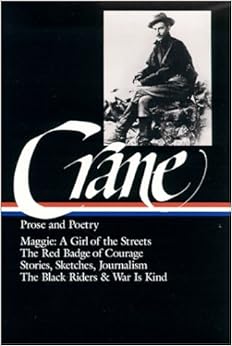
Rachel's Random Recommendation #23: Stephen Crane: Prose and Poetry
I'll go out on a limb here and guess that many of you reading this post have written, at some time in your lives, some really really dark, brooding, jaded, melancholy, depressing poetry and/or prose (I totally did that thing; for me it was in high school).
Well, I have to say that whatever you wrote is sunshine and flower petals and puppy dogs compared to the stuff that poured from Stephen Crane's pen. Now that dude knew how to be nihilistic. I mean, just read some of his poems from The Black Riders (1895) and War is Kind (1896). I'd need a mountainous mound of dark chocolate on hand to read just one of those poetry collections in one sitting, you guys.
Subscribe to:
Posts (Atom)